
Why Monthly Giving Is the Most Reliable Revenue Stream in Uncertain Times
Periods of financial uncertainty test even the strongest fundraising programs. Economic swings, shifts in public funding, donor fatigue, and unexpected crises can make year-to-year—or even quarter-to-quarter—revenue projections feel fragile. For nonprofit leaders responsible for sustaining mission-critical work, predictability becomes just as important as growth.
That’s where monthly giving proves its value. While no revenue stream is entirely risk-free, recurring gifts remain one of the most dependable, resilient sources of income available to charitable organizations—especially when uncertainty is the norm rather than the exception.
Stability Beats Surprises
Monthly gifts provide a level of stability that one-time donations simply cannot. While single gifts fluctuate with campaigns, headlines, and donor sentiment, recurring gifts create a predictable revenue base organizations can plan around. That consistency supports sound decision-making—from staffing and programming to long-term investments—at a time when volatility is the norm.
Monthly donors also tend to be more resilient in the face of external shocks. Because recurring gifts are intentional, budgeted, and automated, they are less likely to be paused during moments of uncertainty. A modest monthly commitment often feels manageable to donors even when they are cautious about larger discretionary spending. For nonprofits, this makes monthly giving a financial buffer when other revenue sources soften.
Recurring Giving Signals Commitment, Not Convenience
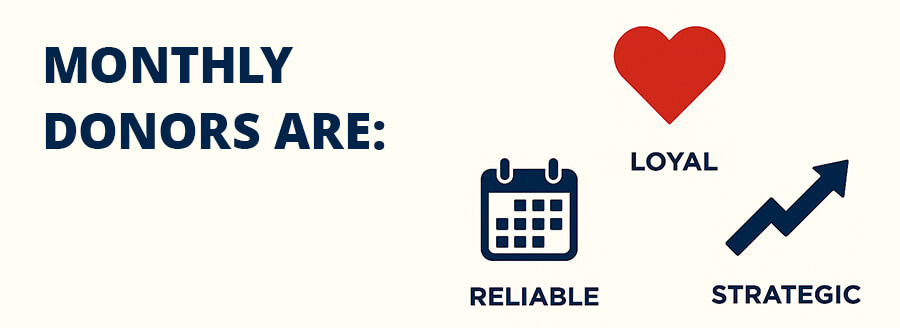
Importantly, monthly donors are not passive supporters. Choosing to give every month reflects a deeper commitment to mission. Over time, these donors typically give more annually, renew at higher rates, and respond more consistently to communications than one-time donors. They are also strong candidates for upgrades, special appeals, and long-term giving options such as bequests. In uncertain times, donor loyalty is invaluable—and monthly giving cultivates it.
Cash Flow Matters More Than Ever
Cash flow is another critical advantage. Many organizations struggle not with total revenue, but with timing gaps between campaign peaks or delayed grant payments. Monthly giving smooths those highs and lows, helping cover ongoing operational costs and reducing reliance on reserves or emergency fundraising.
Monthly Giving Supports Long-Term Thinking
Perhaps most importantly, reliable recurring revenue enables long-term thinking. When organizations aren’t constantly reacting to short-term deficits, they can invest in staff capacity, donor stewardship, impact measurement, and innovation. Monthly giving doesn’t just sustain today’s work—it creates space to build a stronger future.
Reliability Requires Care
That reliability, however, depends on care. Clear communication, consistent acknowledgment, and meaningful impact reporting are essential to maintaining donor trust. Monthly giving is dependable because donors feel connected to the mission they’re sustaining.
A Strategic Imperative, Not a Backup Plan
In uncertain times, organizations often ask, “How do we replace lost revenue?” A better question may be, “How do we reduce our vulnerability to uncertainty in the first place?”
Monthly giving is one of the strongest answers to that question. It smooths revenue, strengthens donor relationships, and supports long-term resilience in ways few other fundraising tools can.
For nonprofits planning for an unpredictable future, monthly giving isn’t just dependable—it’s indispensable.
Looking to strengthen or grow your monthly giving program? The experts at IDM work with nonprofits every day to build sustainable membership and recurring revenue strategies that drive long-term impact. If you’re ready to take a more intentional approach to monthly giving, we invite you to connect with an IDM strategist to explore what’s possible for your organization.